
INTRODUCTION
BOTOX® COSMETIC
Men and women find that wrinkles of the forehead, between the eyebrows (glabella), bridge of the nose, and crow’s feet make them look older and tired. Not only do these changes affect the perception of others, but self-perception is affected as well. Even self-confident patients report an enhanced self-image. It is tempting to speculate whether the physical inability to frown may have any positive emotional effect. Rather than emotions affecting facial expression, can facial expression affect emotions?
How It Works
Botox (botulinum toxin type A) is taken up locally by the nerve endings and blocks the release of the neurotransmitter acetylcholine. The nerve endings recover function in about 3 months, but the antiwrinkle effect typically lasts 4 months. Botox is one of the few treatments that is effective and has no downtime (HA fillers are others). This powerful toxin is injected in extremely minute quantities. It paralyzes (the kinder term is “relaxes”) the facial muscles. Paralyzing these muscles removes the contracting force on the overlying skin. This contracting force is what creates the wrinkles in the first place.
Eyebrow Shape
Eyebrow position and shape greatly affect our appearance and how our mood is interpreted by others. A depressed medial brow gives the impression of anger and disgust. Elevation of the lateral brow produces a “surprised” look. Over-elevation of the medial brows can make people look sad. It is remarkable how a few mm movement of the brow in one direction or the other can alter how others perceive your mood. Such differences can have very real social implications. No wonder Botox was so quickly embraced, not only for its antiwrinkle effect, but also for its ability to influence eyebrow position and shape.
Cosmetic Uses of Botox
Botox works very well for:
• Forehead muscles
• “Corrugator” muscles that cause frown lines
• “Bunny lines” on the bridge of the nose
• Crow’s feet
• Chin dimpling or “cobblestoning”
Botox can also help:
• Upper lip vertical wrinkles “smoker’s lines”
Operators have used Botox to treat the lower face, but there is a risk of weakening the smile or the corner of the mouth, so it is less useful here. The lower face is better treated with fillers and laser resurfacing.
Botox Relaxes, Hyaluronic Acid Refills
Frequently, patients confuse Botox with HA (hyaluronic acid) fillers such as Restylane and Juvéderm. Botox is a toxin that relaxes muscles but has no substance. It is a liquid that is absorbed and has no bulk. Fillers are simply inert spacers used to fill in creases.
Botox Cosmetic and Migraine Relief
Many patients report that their migraine headaches are improved after Botox injection. They have fewer episodes and their symptoms are less severe. Some patients report that they no longer experience the nausea that used to accompany their migraine attacks. This is a particularly welcome side effect for these patients. Perhaps this relief is due to reduced compression of the sensory nerves that supply the forehead. In such patients, Botox serves dual purpose, relieving wrinkles and frontal headaches.
Safety
Patients generally know that Botox is an extremely powerful poison. They wonder how safe it is to be injected with such a substance. They are reassured to learn that the amount injected is so infinitesimal there is no detectable level of the toxin in the bloodstream after injection. In fact, Botox vials would not make a good bioterrorism agent because it would take about 300 bottles to achieve a lethal inhaled dose in humans and much more for a lethal oral dose! There are some neural diseases that are contraindications to Botox injection, such as ALS (Lou Gehrig’s disease), Lambert-Eaton syndrome, and myasthenia gravis.
FROWNING
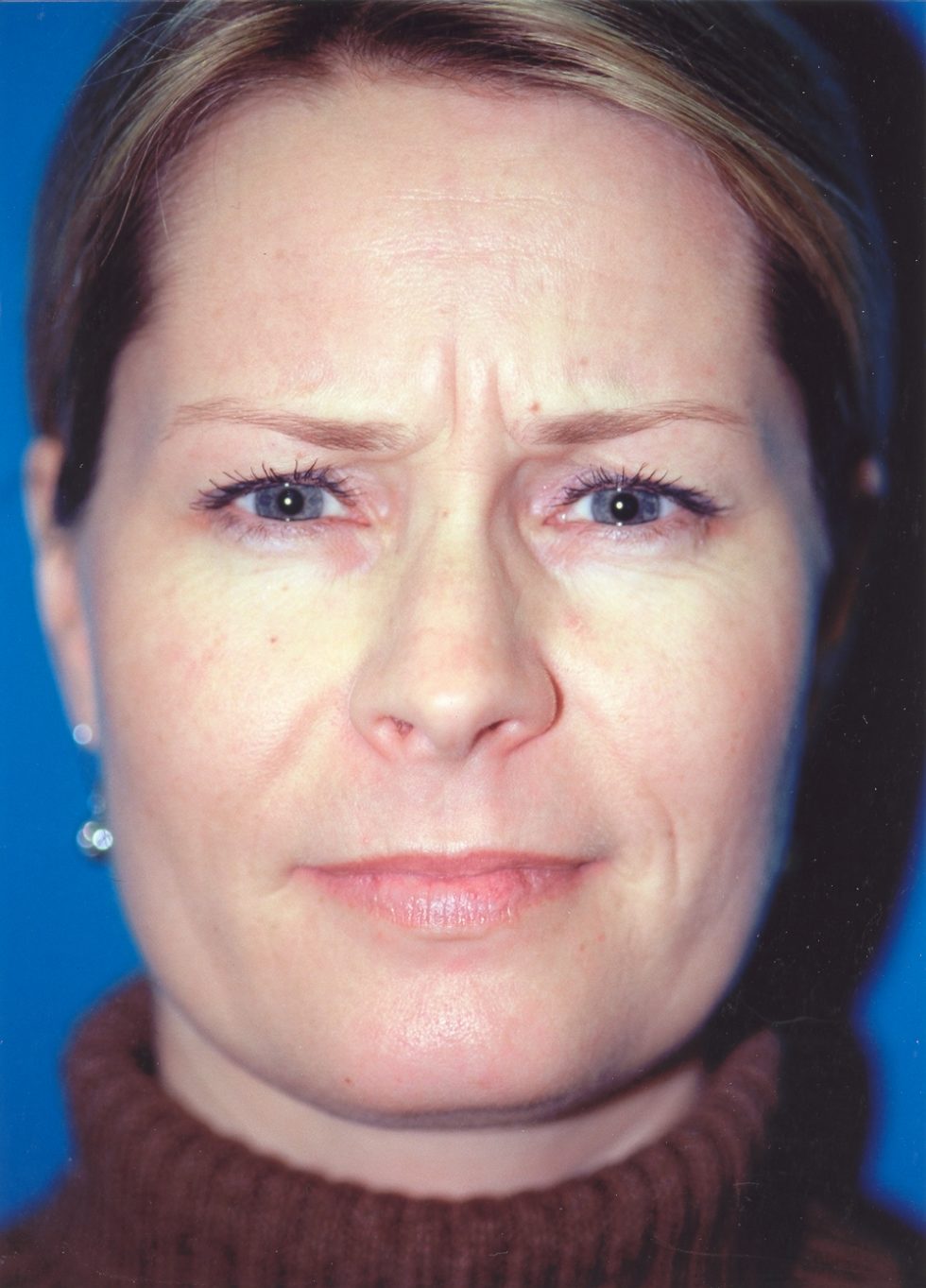
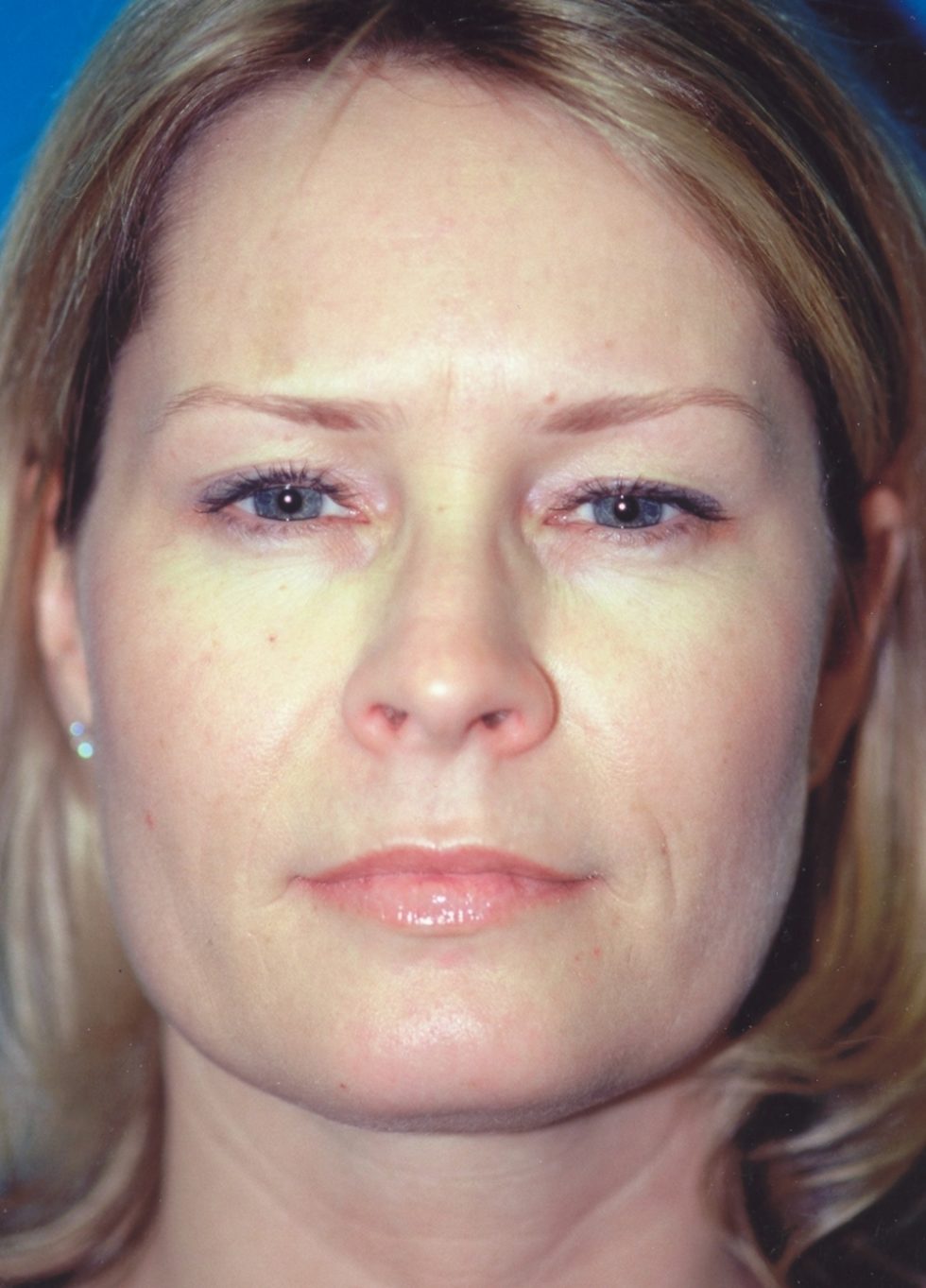
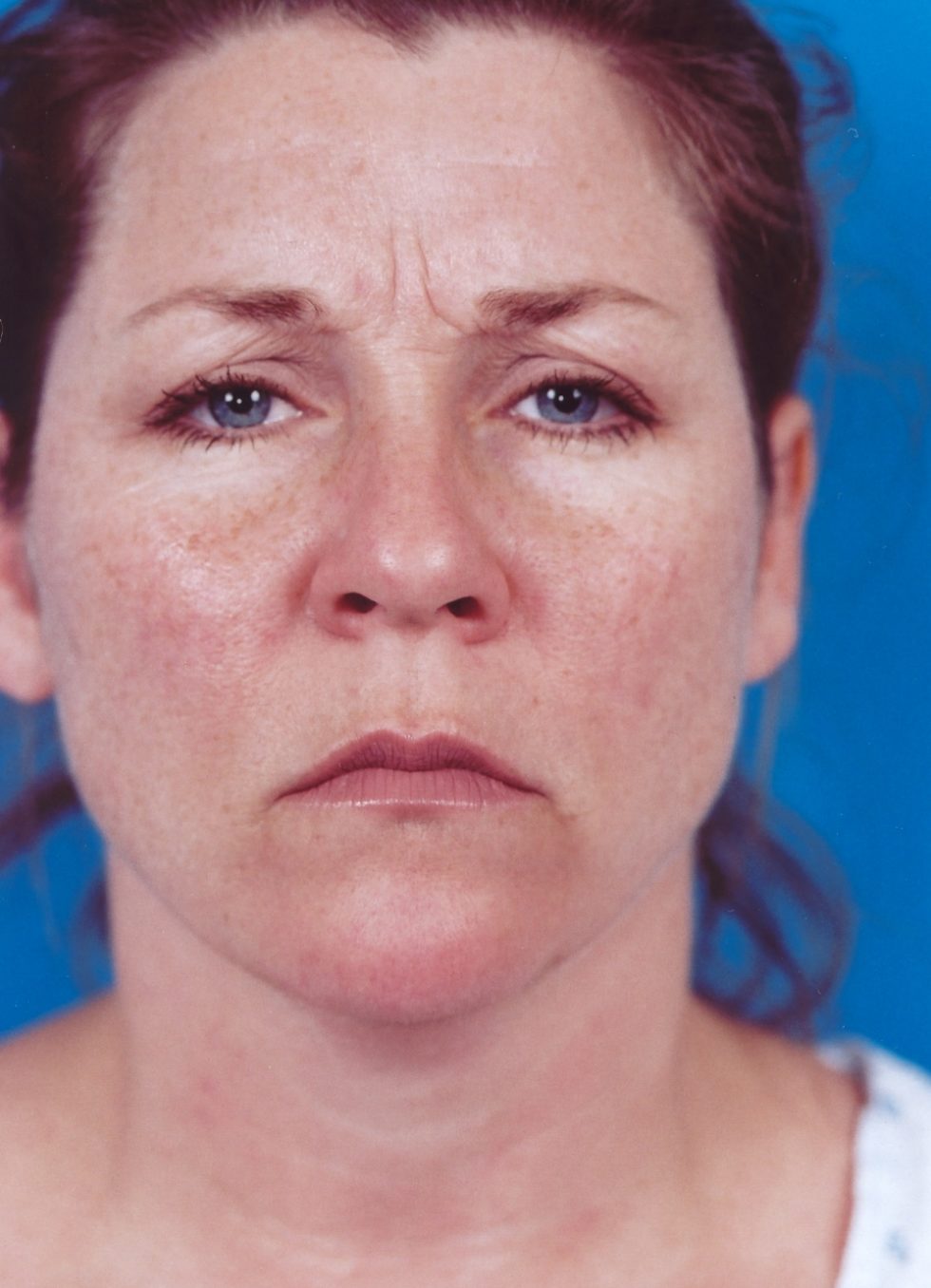
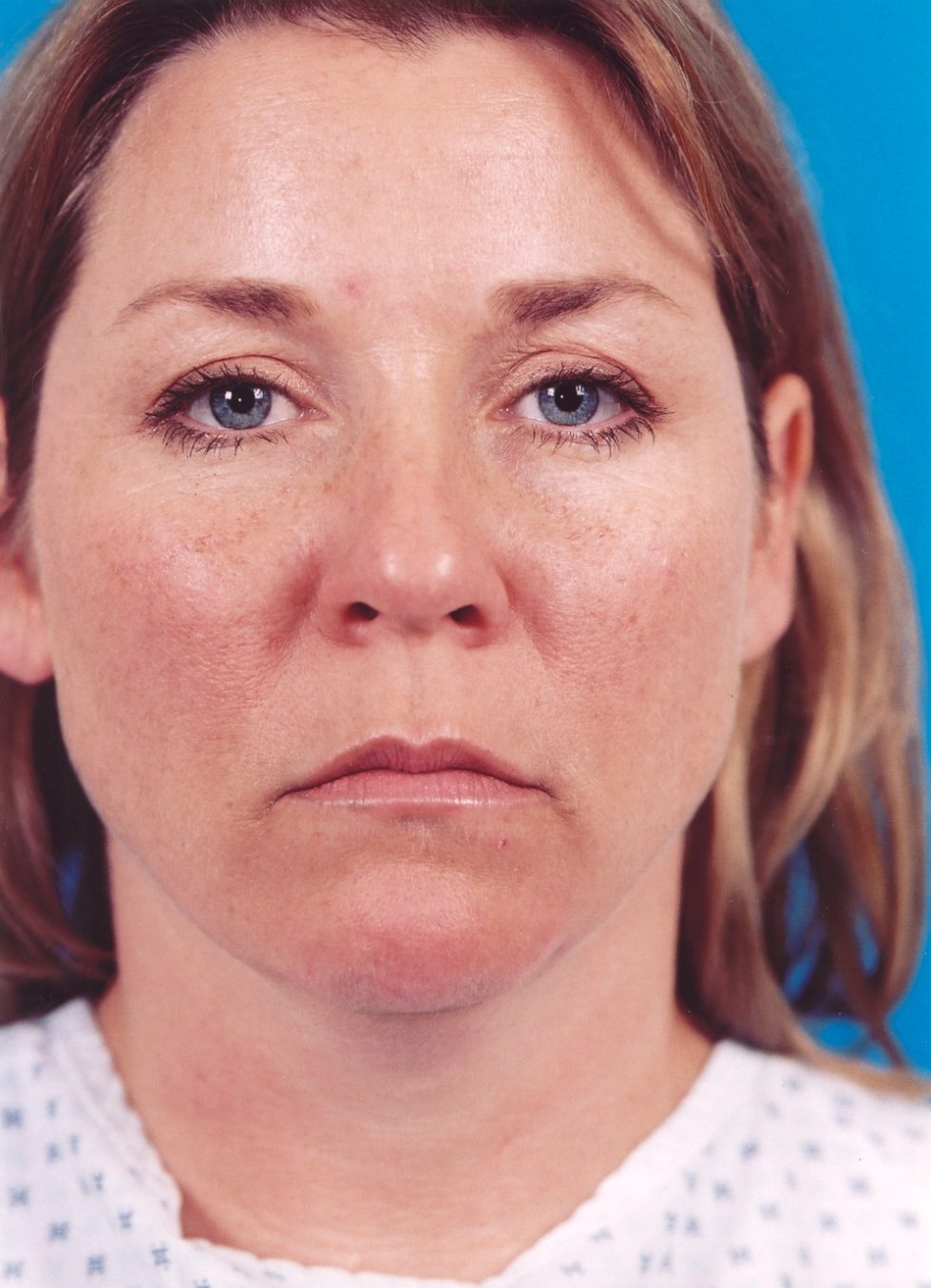
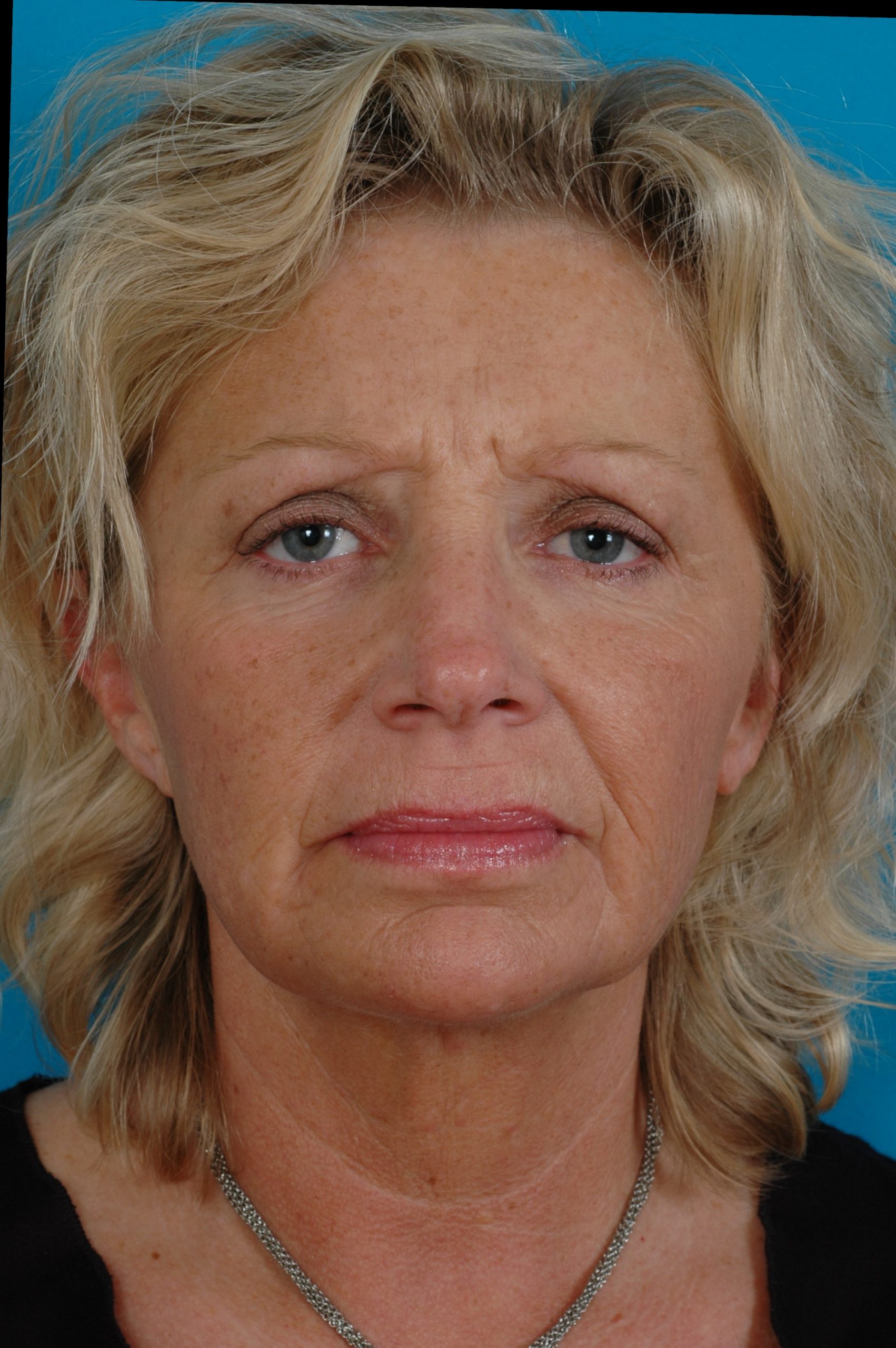
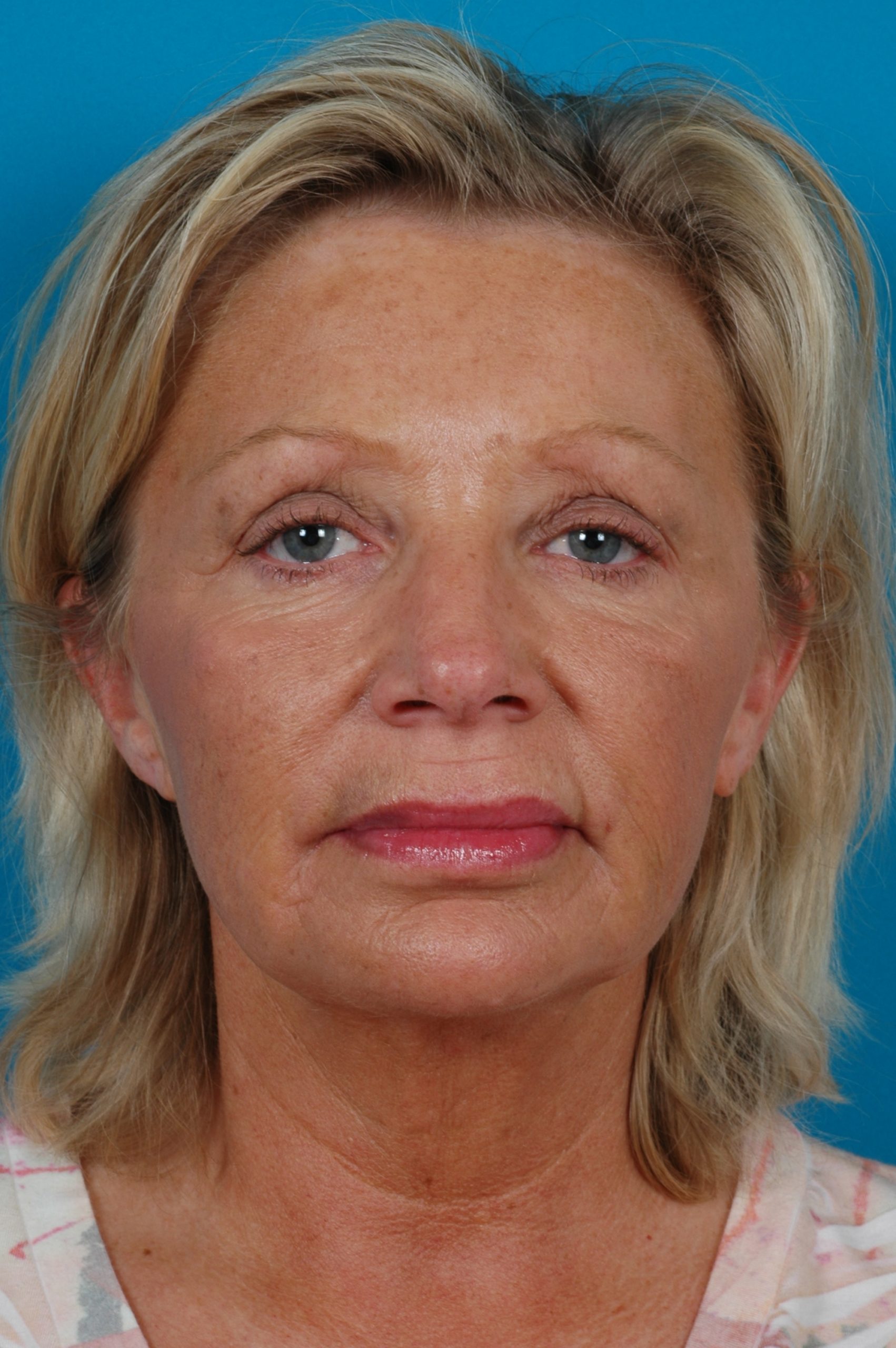
LIFTING
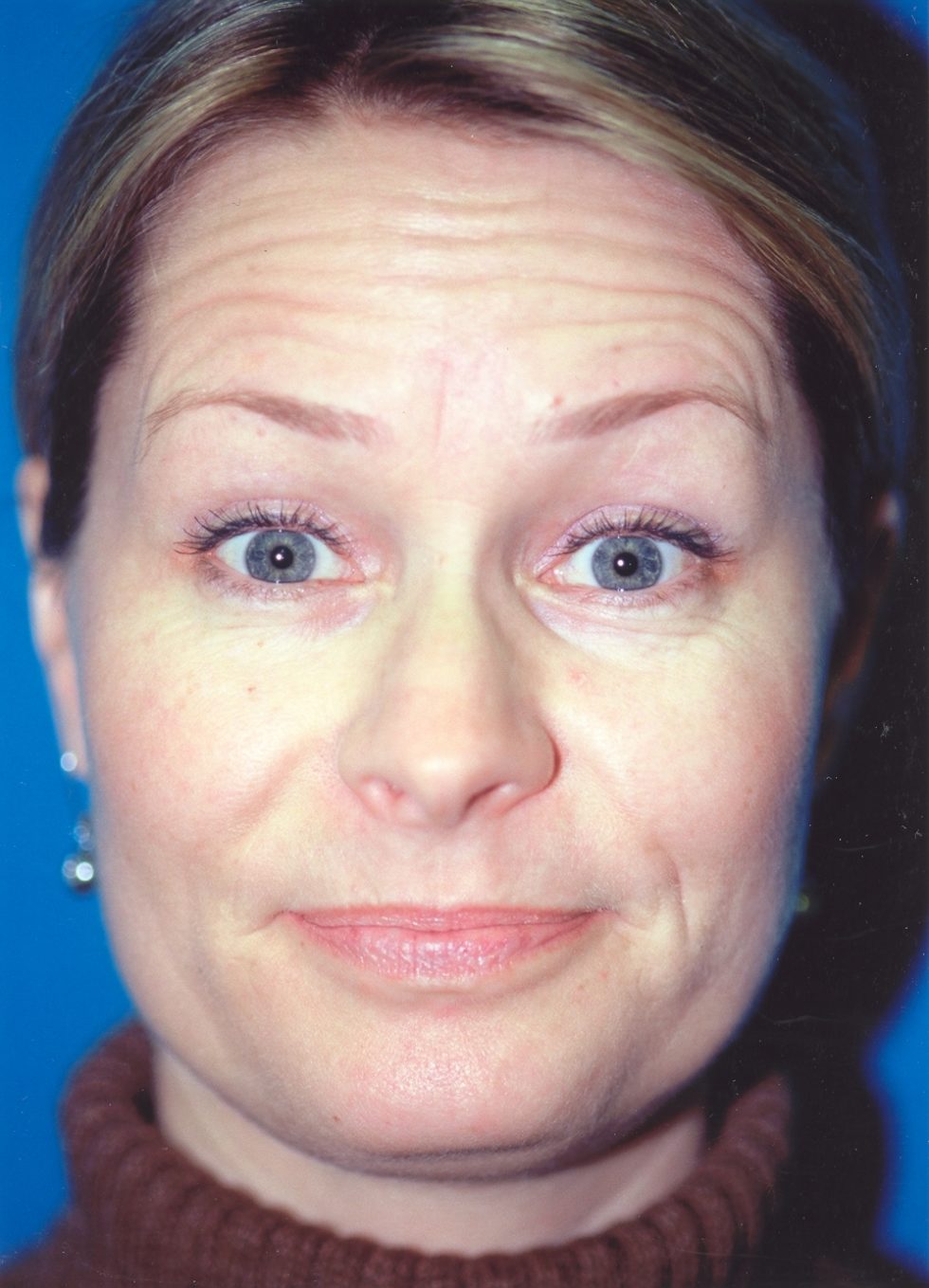
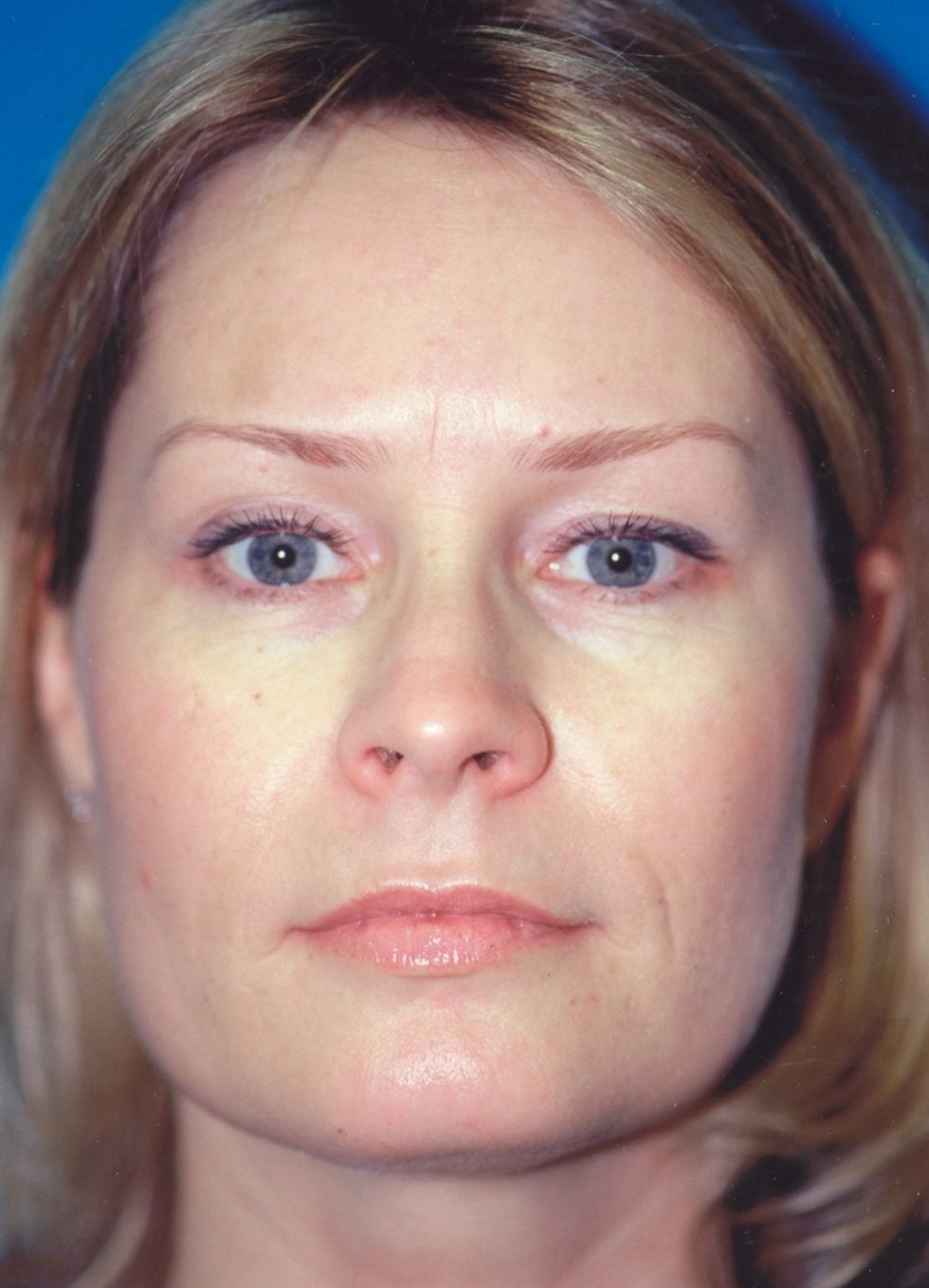
RESTING
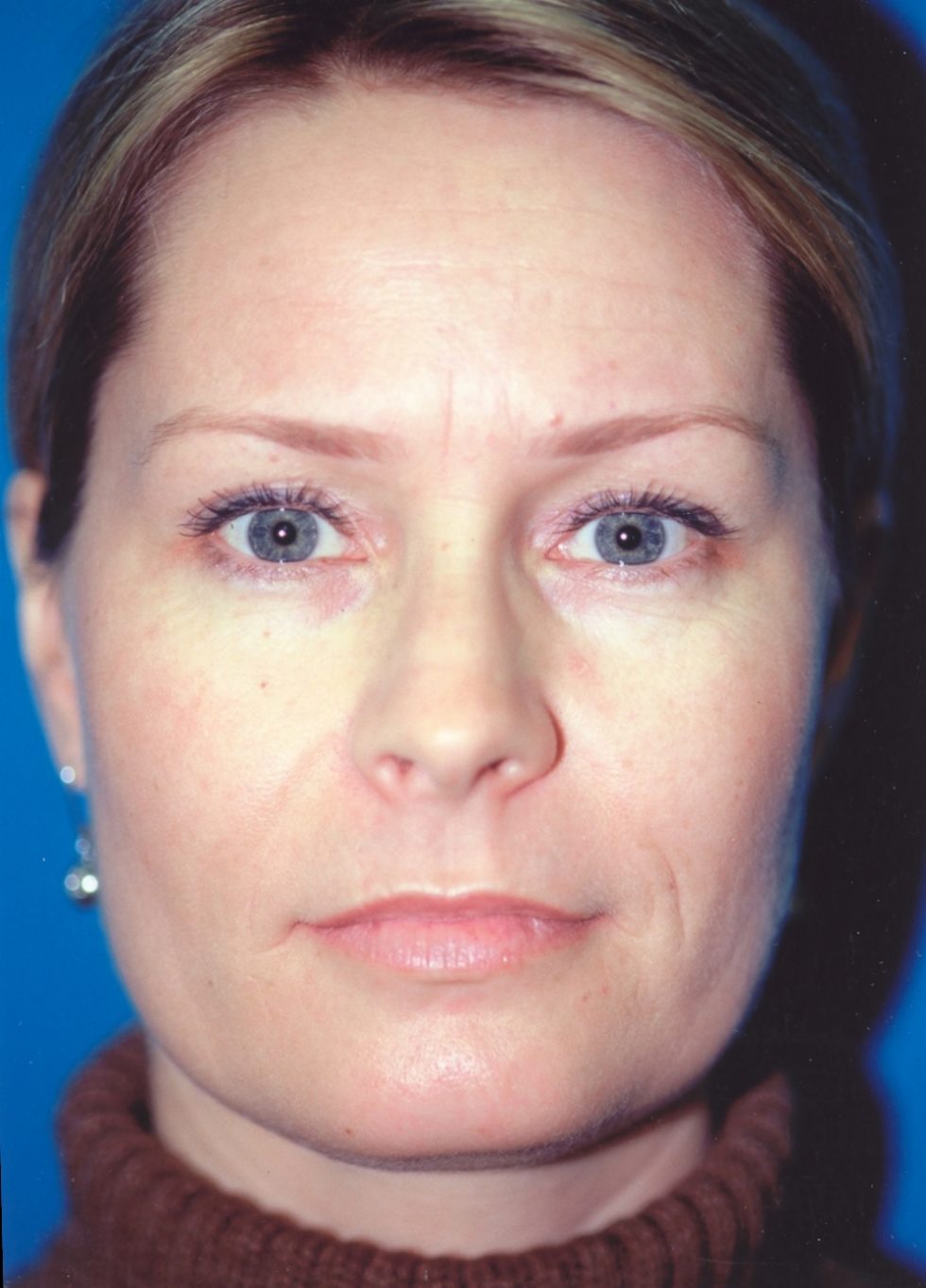
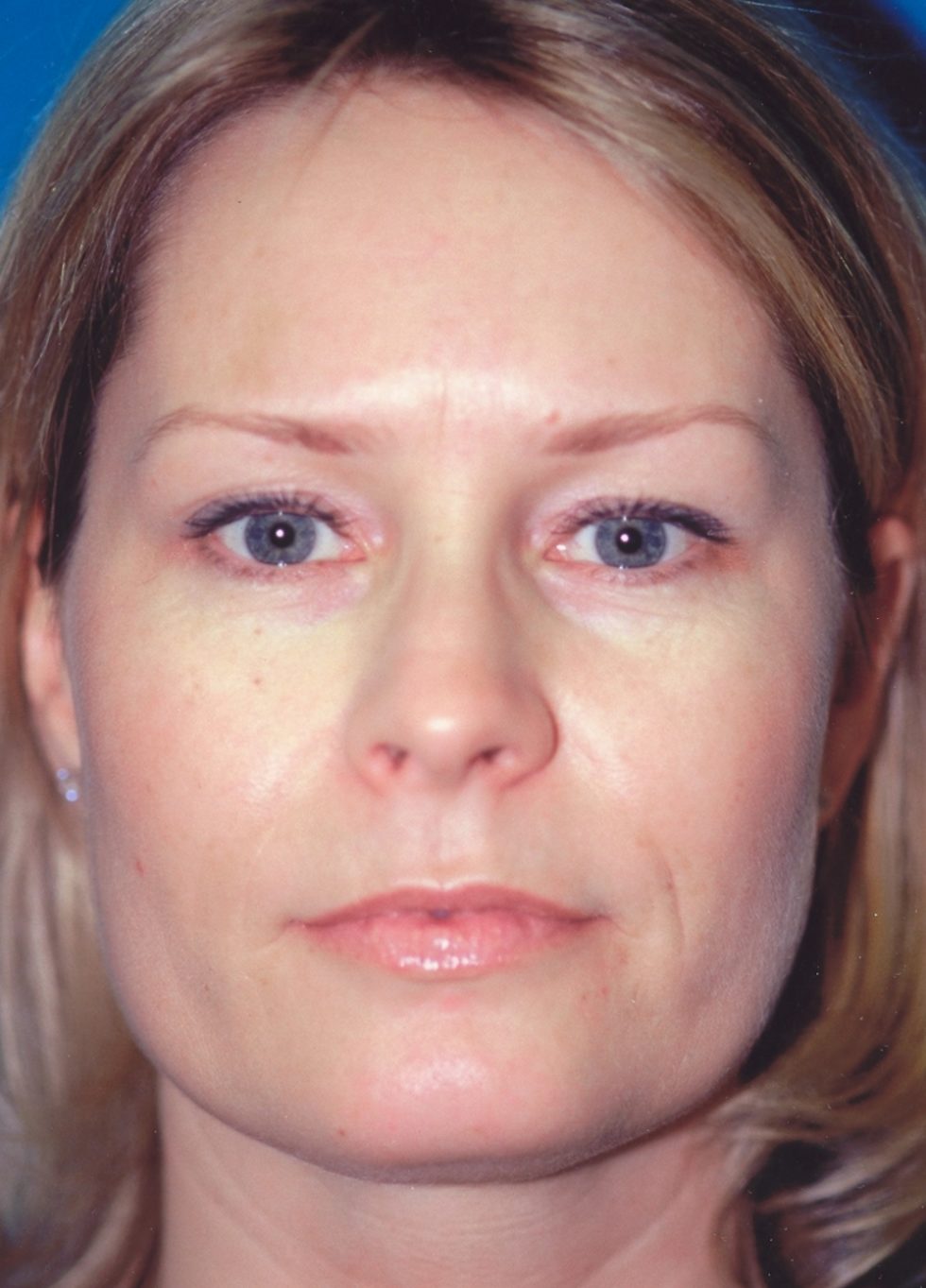
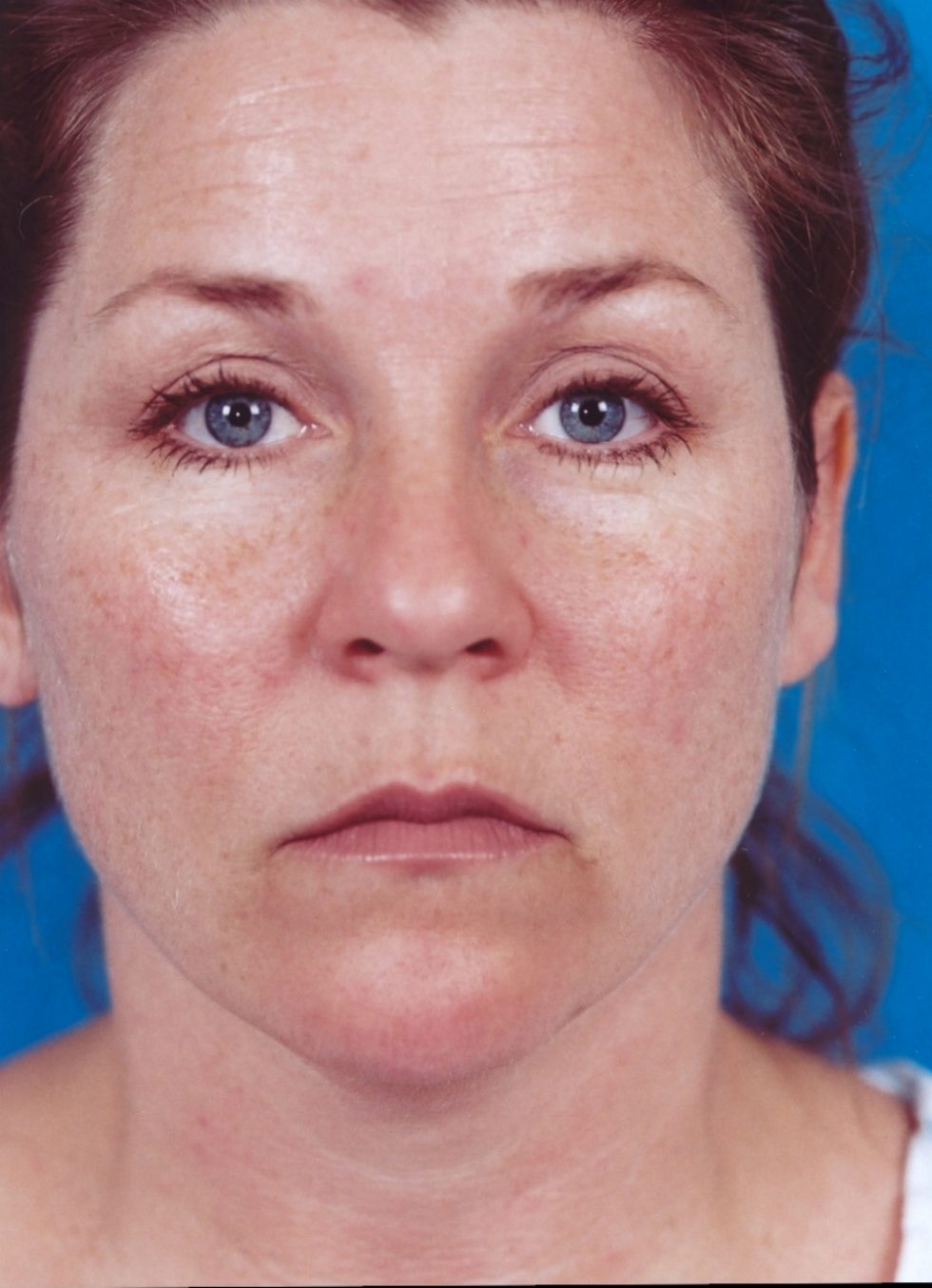
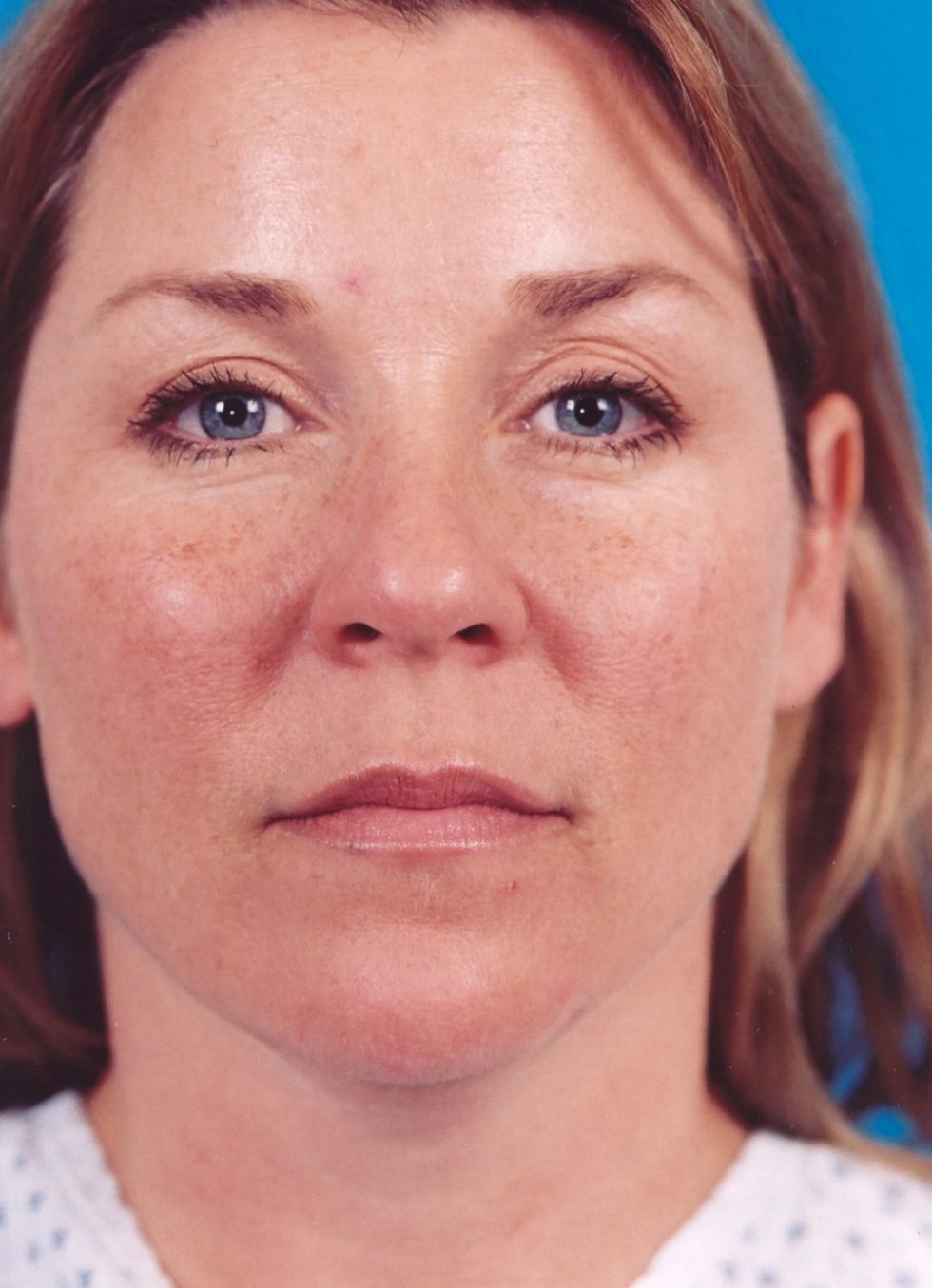
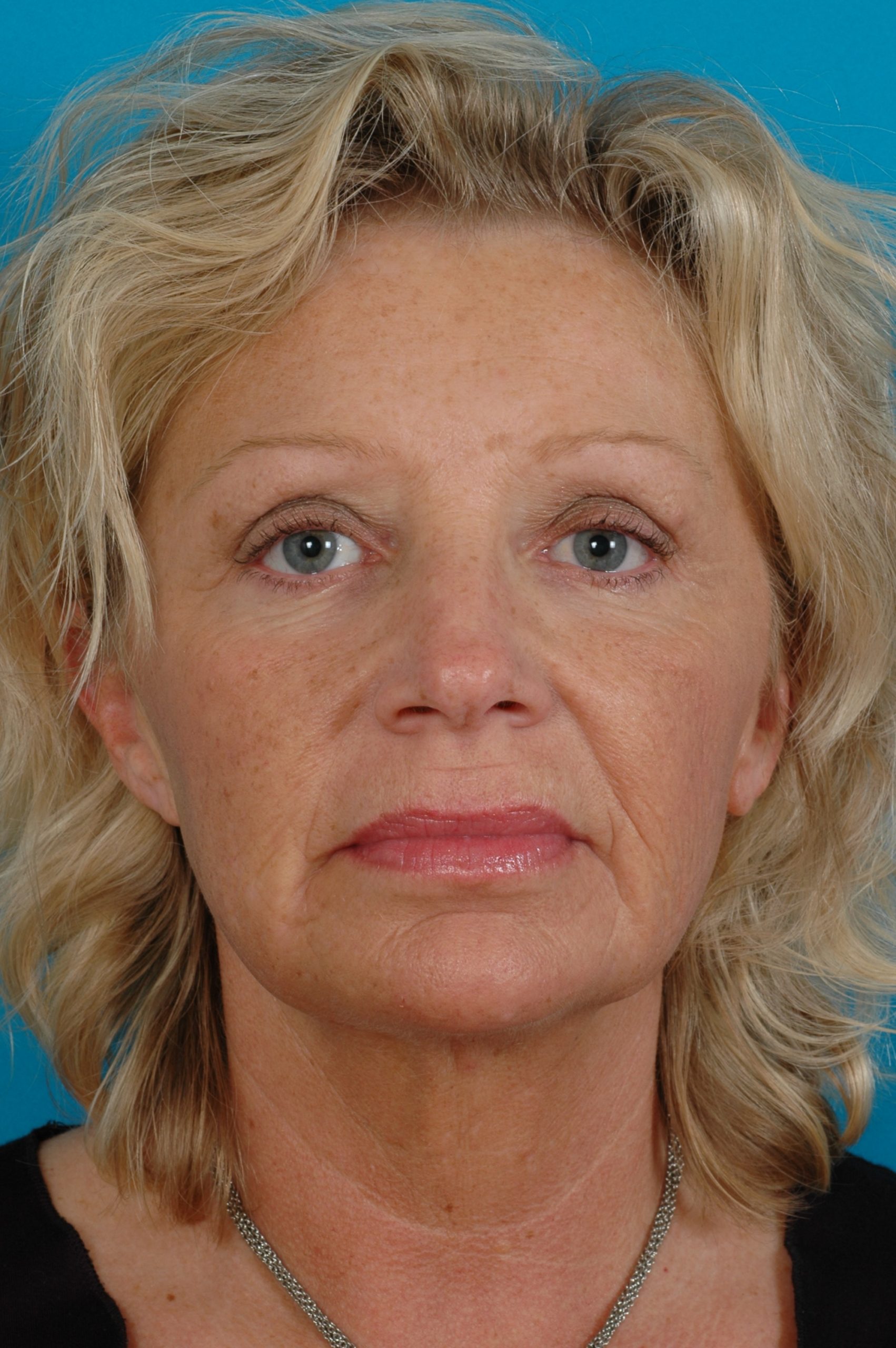
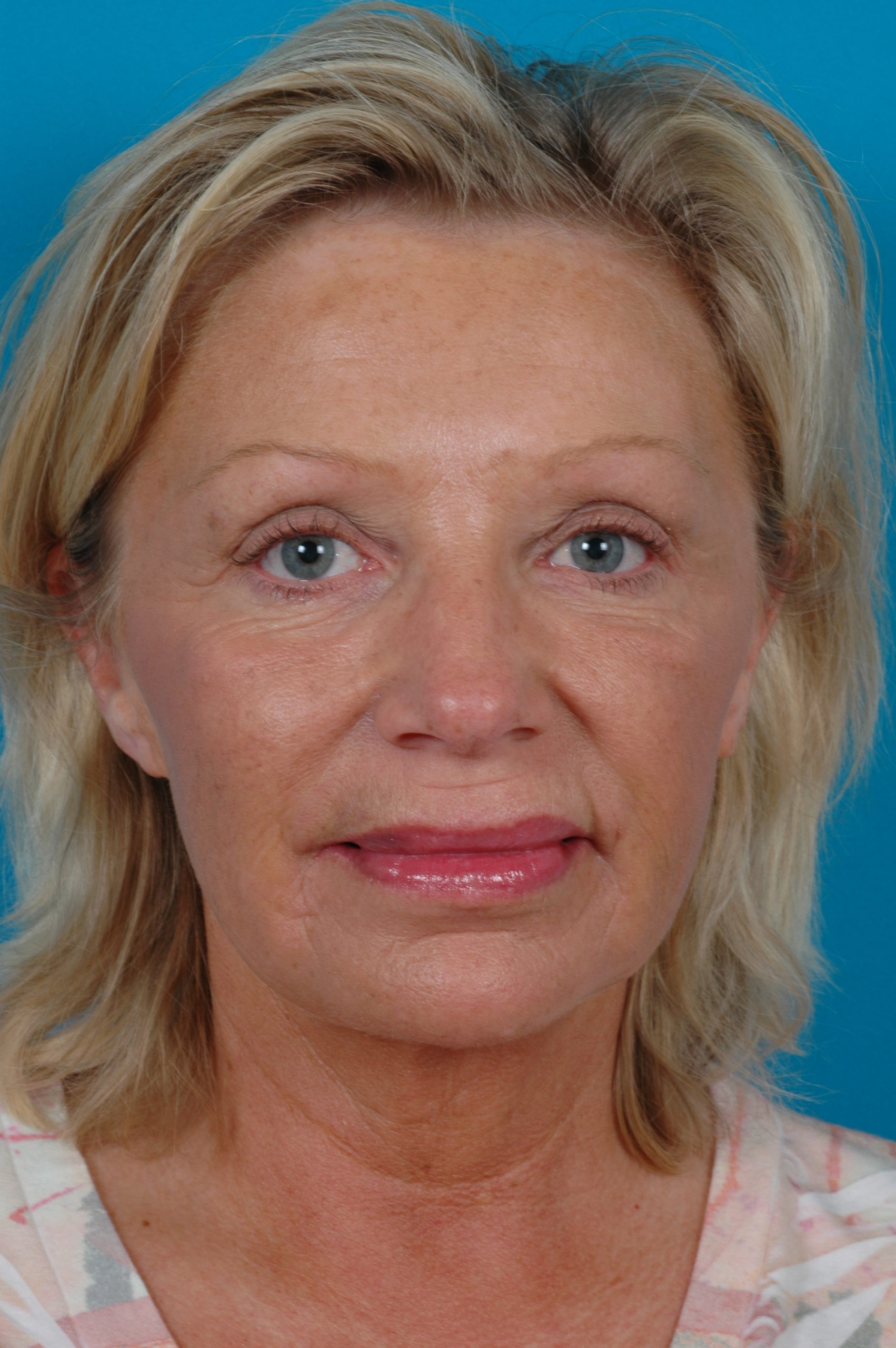
PHOTOS OF PATIENTS WITH BOTOX COSMETIC
L.M., Age 36
Procedure: Botox Cosmetic injection of the forehead and crow’s feet.
Description: Injection of forehead and crow’s feet
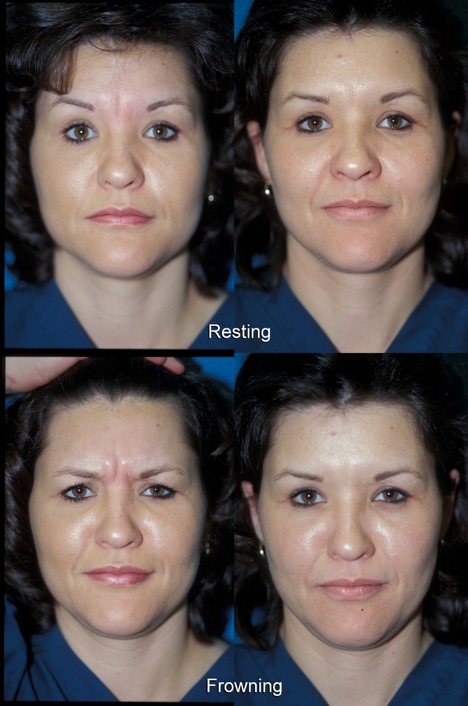
Before, 7 days after
M.C., Age 36
Procedure: Botox Cosmetic injection of forehead.
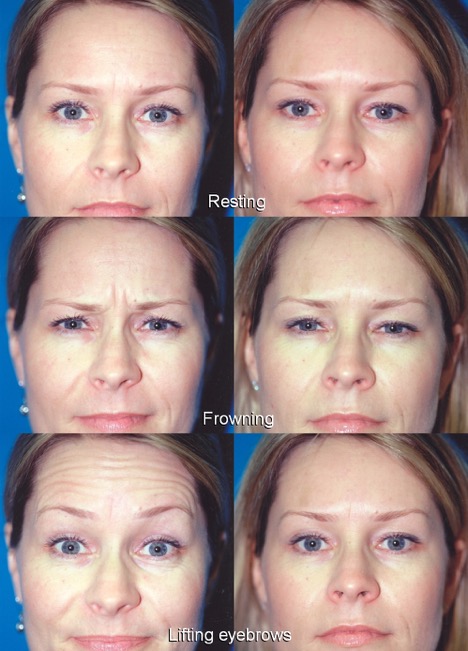
Before, 9 days after
A.D., Age 39
Procedure: Botox Cosmetic of forehead and crow’s feet
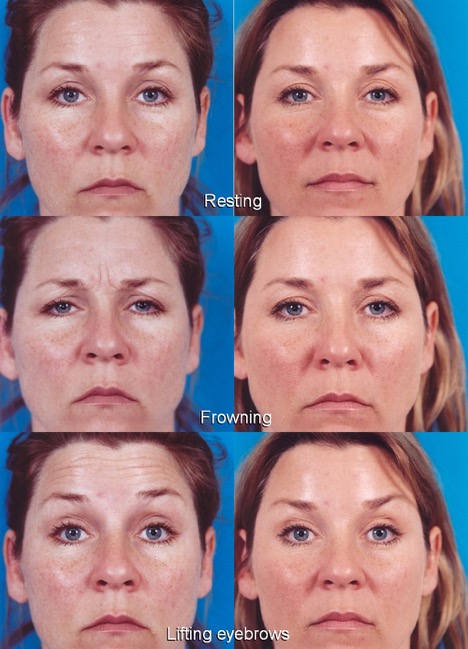
Before, 9 days after
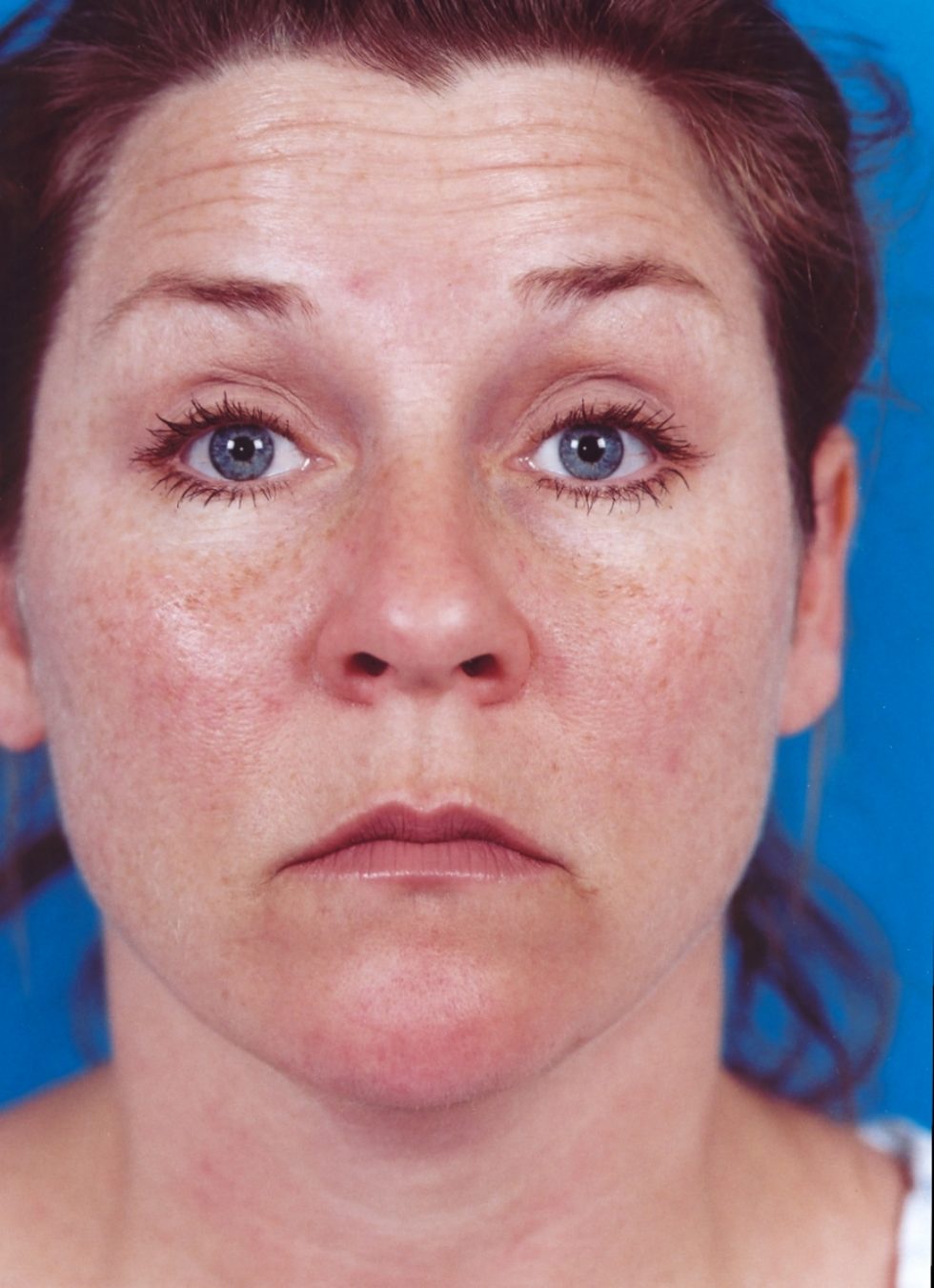
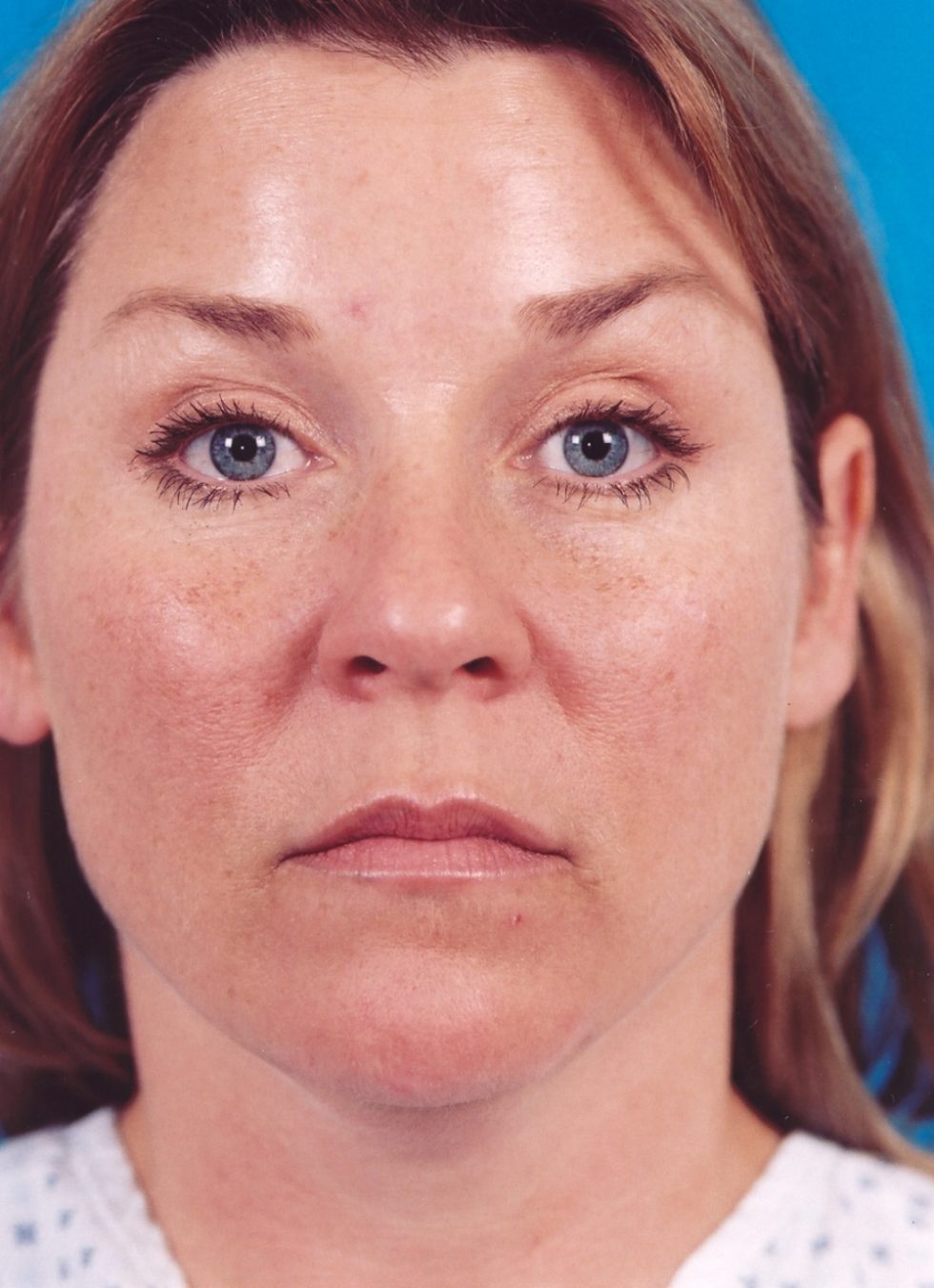
T.H., Age 49
Procedure: Botox Cosmetic injection of forehead, including glabella, and crow’s feet; and Juvéderm Ultra Plus injection of lips, perioral lines (creases around the mouth), and nasolabial creases (two syringes).
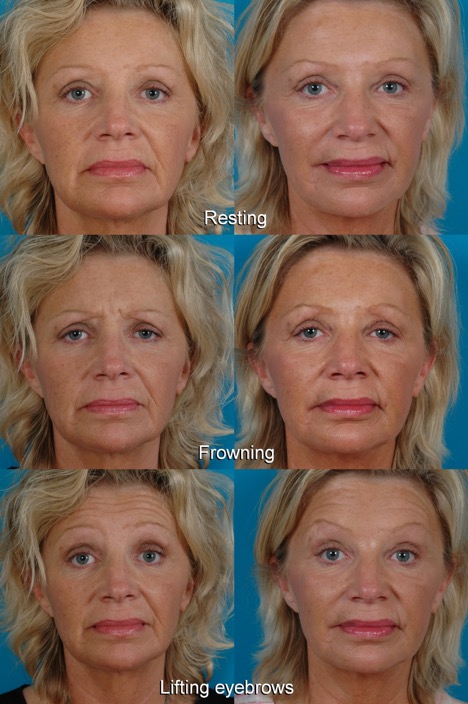
Before, 6 days after
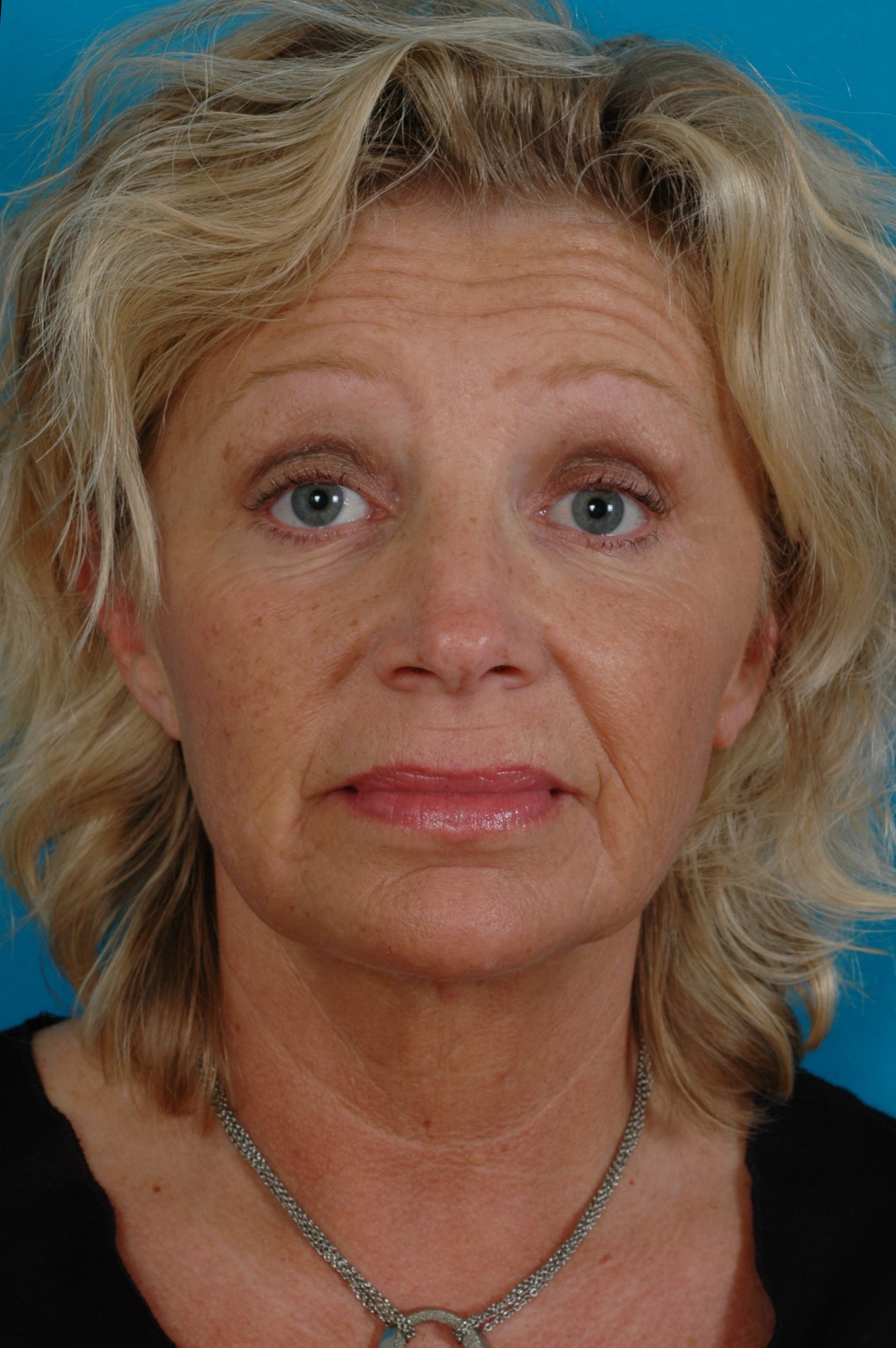
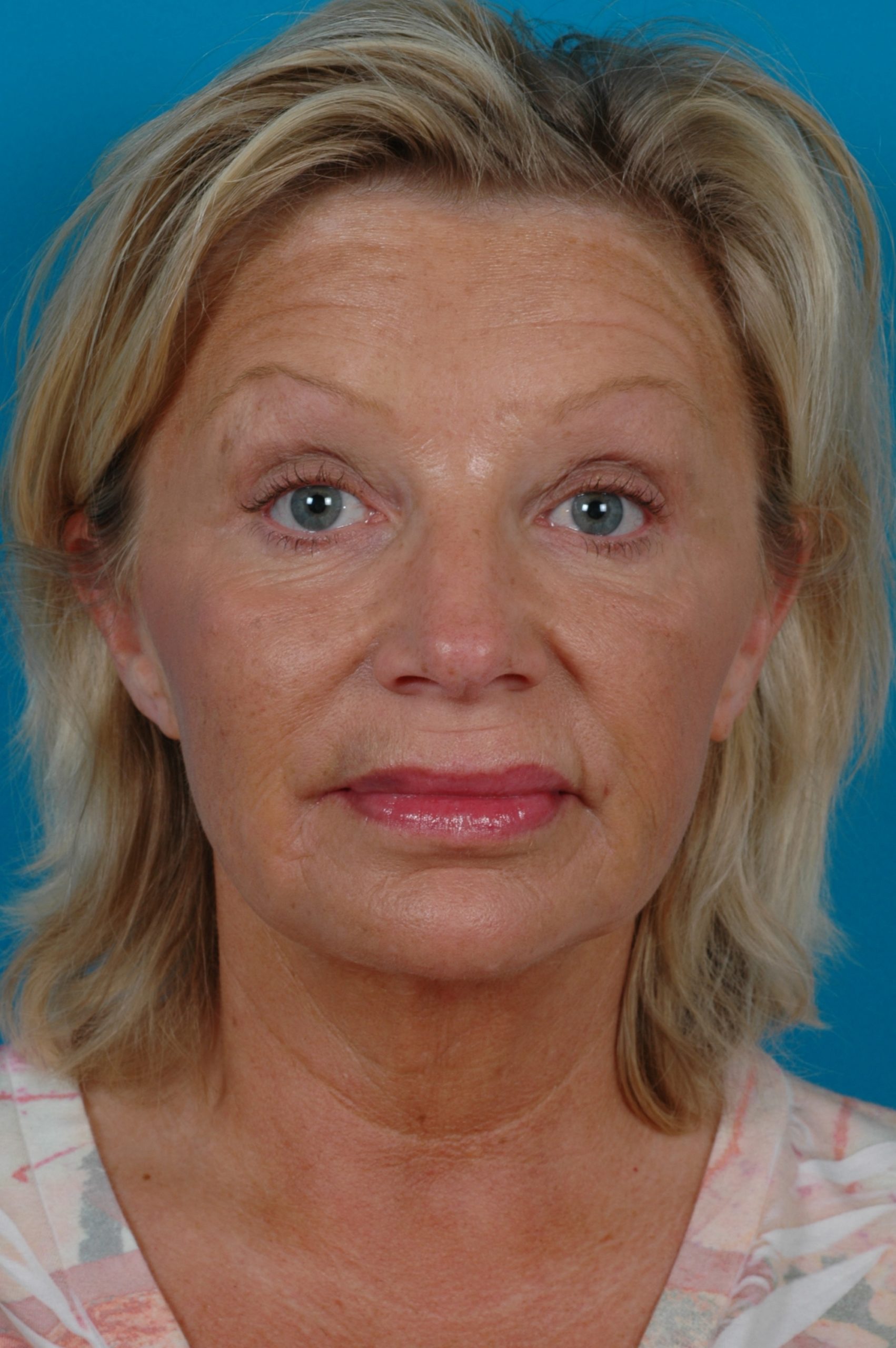
T.A., Age 51
Procedure: Botox Cosmetic injection of forehead and crow’s feet and Juvéderm injection of perioral lines (creases around the mouth).
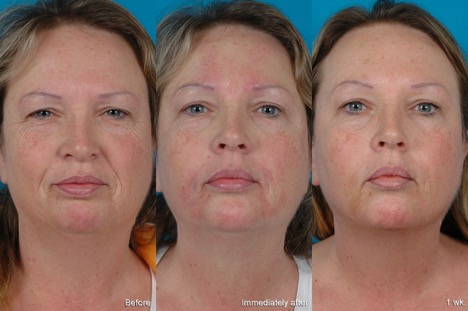
Before, immediately after, 1 week after
How It Is Done
Botox Cosmetic
Botox is injected using a small, 30-gauge needle into the muscles that are to be paralyzed. The muscles that create frown lines run perpendicular to the wrinkles. The skin folds on itself when the underlying muscle contracts. The corrugator muscles are particularly well named, referring to the corrugated appearance of the skin when this muscle contracts, like an accordion.
The muscle that causes a crease at the bridge of the nose is called the procerus (See Illustration). The orbicularis oculi muscles run in a circular fashion around the eyes. The vertically-oriented muscle that produces horizontal forehead wrinkles is the frontalis. Weakening these muscles removes the force acting on the skin to cause wrinkles from repetitive skin contraction.
By reducing the force pulling down on the eyebrows, it is possible to achieve a “chemical lift” of the eyebrows in many patients. This result is highly dependent on the operator’s skill and the effect varies between patients. Botox is injected on either side of the brow to weaken the forces of the muscles pulling down on the brow, allowing the frontalis to pull up with less opposition. Typically, the frontalis muscle is also intentionally weakened to smooth forehead creases, so this needs to be done judiciously to avoid overtreating the frontalis, which might cause the eyebrows to drop rather than lift up.
Botox Injection is a Medical Treatment
Botox injection, like liposuction, appears remarkably simple to do. It is done by doctors, nurses, aestheticians, and others in medical offices, spas, and back rooms across the country. For a while, “Botox parties” were popular. Indeed, there is nothing difficult about injecting Botox.
But the fact that administering Botox is technically simple does not mean it should be done by unqualified operators. The knowledge of how much to inject and where to inject it comes from experience.
Avoiding Over treatment
It is possible to produce a “devilish” expression. The lateral brows go up but the rest of the brows stay down. Patients of mine have called this undesirable look “Spock-like” and “like Jack Nicholson.” Fortunately, this problem may be corrected by injecting more Botox in the lateral forehead. I tell my patients to let us know if this happens and come back for a touch-up.
No one wants to have a motionless or mask-like facial expression. One of my nurses told me her children needed to know when she “meant business.” With experience, the operator learns to avoid creating a devilish appearance, preserve animation, minimize wrinkles, and even produce a lift of the brows. This is the art of Botox injection.
Is Botox Painful?
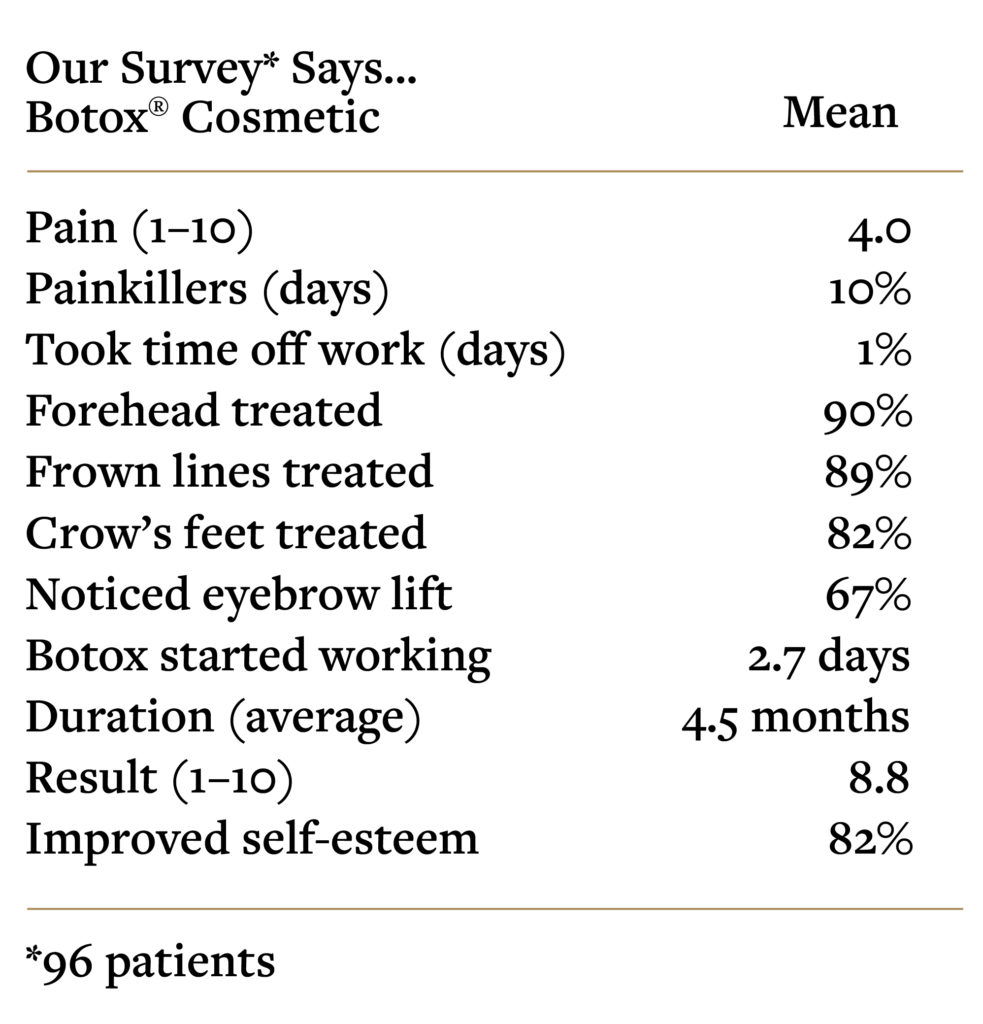
Yes. The procedure involves numerous needle pricks to the forehead, bridge of the nose and crow’s feet. The most tender spot is between the eyebrows (glabella) where the corrugator muscles can be quite thick. I usually treat this area first. Fortunately, the upper forehead and crow’s feet are less painful and the procedure takes just a few minutes.
Some operators apply a topical anesthetic before Botox injection. To be effective, this should be left on for at least 30 minutes. Some patients prefer the application of an ice pack to their forehead prior to treatment and immediately after. Both of these techniques are probably helpful, but most patients have the treatment without any such preparation. Commonly, I inject Botox and filler at the same visit, Botox for the forehead and crow’s feet—and an HA filler such as Juvéderm for the nasolabial creases and lips.
Preparing for Botox
It is preferable to have no makeup on the area at the time of injection. I routinely use an antiseptic wipe to clean the skin before the injections.
Avoiding Bruises
There is a small amount of bleeding from the needle pricks. I avoid any superficial veins as much as possible but some are invisible under the skin. If I do happen to prick a vein, I immediately apply pressure and have the patient hold pressure for several minutes. This minimizes bruising.
What To Expect After Surgery
There may be some bruising after Botox injection that can be covered with makeup. There may be little bumps at the injection sites that settle down within an hour of treatment. This is the fluid that is absorbed. Botox injection can be done over a lunch hour.
Although practitioners have recommended limiting activity and bending over for a few hours after injection, this does not have a scientific basis. I do not recommend any limitations on activities after injection.
Some doctors recommend that patients actively contract their muscles after treatment. The theory is that this will help the nerve endings take up the toxin. Whether this really happens is an open question. I don’t instruct my patients to do this.
“Can I have a facial right after having Botox?”
It is generally recommended that the areas not be massaged immediately after injection to limit possible diffusion of the Botox so it does not get taken up by adjacent muscles, such as the muscle that elevates the upper eyelid (“levator palpebrae superioris”). It is preferable to have the facial (or microdermabrasion) first, then Botox.
Resistance to Botox
Some patients may be resistant to Botox treatments, possibly because of the development of antibodies. I have encountered this in a single patient whose corrugator function persists despite Botox injection.
Persistent Wrinkles
Sometimes patients wonder why they can still see wrinkles above the middle and lateral portions of the eyebrows after Botox injection. They are pleased with the smoothness of the middle of the forehead and would like to have these lateral forehead wrinkles softened too. The concern is that treatment of these areas risks dropping the brows. Patients readily understand this concept. In this situation I may inject a tiny amount of Botox in the lateral forehead, softening the crease without dropping the brow.
Complications
Allergic Reaction
An allergy to Botox is rare but possible and one reason why injections are best done in a medical office, rather than someone’s living room (with reference to Botox parties) so that an acute allergic reaction may be treated.
Headaches
Headaches are sometimes reported after injection, but at the same rate as for placebo injection, suggesting that injections themselves are responsible for this side effect, not the Botox.
Droopy Eyelid (Eyelid Ptosis)
A droopy eyelid is seen with some regularity (3%) in large series of patients. This problem is thought to be caused by diffusion of the toxin down to the levator muscle, which pulls up on the upper eyelid. Of course, the operator does not inject Botox directly into the upper eyelid. When injecting the corrugator muscle above the medial portion of the brow, some of the Botox may travel down to this muscle. To avoid this problem, experienced operators stay above the eyebrow with their injections, and avoid injecting over the central portion of the brow.
Droopy Eyebrow (Eyebrow Ptosis)
The other reason to avoid injecting over the midportion of the eyebrow is that this weakens the frontalis muscle that pulls up on the eyebrow. The eyebrow drops, the opposite of the desired eyebrow elevation. A flattened eyebrow is not only is undesirable, but can cause the skin of the upper eyelid to drop too. This can be troublesome for the older patient who may be in the habit of (unconsciously) using the frontalis to lift the eyebrow and take up the slack in the skin of the upper lid.
Care After Treatment
Botox injection is one of the few effective treatments that have virtually no downtime or need for aftercare. Some operators recommend that their patients intentionally frown and wrinkle their forehead after the injection (theoretically to help the nerve endings take up the toxin), or avoid physical activities and bending over for about 3 hours, but the science is lacking. I have encountered no problems having my patients return right away to normal activities.
FAQ’s
Q: When will it start working?
A: It takes about 2 days to work.
Q: How long does the effect last?
A: About 4 months.
Q: Is it true that Botox can lift your eyebrows?
A: Yes, it’s possible. By paralyzing the muscle that pulls down on the eyebrows (the orbicularis muscle), the muscle pulling the eyebrows up (frontalis) is able to do so more easily, raising the eyebrows slightly. This is called a chemical lift.
Q: Will Botox help my smile creases or lip lines or do I need a filler instead?
A: Vertical creases of the upper lip (smoker’s lines) may be improved with small doses of Botox in the upper lip. Smile creases (“nasolabial creases”) are better treated with filler. Injection of filler also helps smoker’s lines by plumping up the lip along its length. Individual deep vertical creases of the lip (“radial lip lines”), may be injected with filler too. Laser resurfacing is effective for lines around the mouth too.
Q: What can be done for the dimples on my chin?
A: This is called cobblestoning, one of my personal favorite names (along with “bunny lines”). This unwelcome dimpling of the chin is well-treated with Botox, which reduces the muscle action responsible for this dimpled appearance.
Q: What about treating my neck?
A: Many practitioners treat “platysmal bands” of the neck with Botox. This does require a substantial (i.e. expensive) amount of Botox and the results are modest. There is additional risk in this off-label use, such as difficulty swallowing if the toxin penetrates to deeper muscles. I prefer surgical treatment of platysmal bands.
Q: I am pregnant. Can I still have Botox?
A: There is simply no data on the safety of Botox injection during pregnancy. Therefore, the manufacturer recommends that Botox not be administered during pregnancy or to nursing mothers.
Q: Does it hurt?
A: Yes, it does. I use the small 30-gauge needle, but you still feel a number of pinpricks. Fortunately, it only takes a couple of minutes to do.
Q: Does Botox help crow’s feet?
A: Yes, it especially helps the “dynamic” wrinkles that occur when you smile. “Static” wrinkles that are there all the time may need additional treatment using laser resurfacing.
Q: Can bruising occur?
A: Yes, it is possible. But usually any bruising is a small area and will resolve within a week. Makeup may be used to cover it.
Q: If I keep having the treatments, does the interval between treatments get longer?
A: The idea makes sense—atrophy of the muscle from disuse. However, there is not a good scientific answer for this question. Some of my patients, whom I’ve treated for years, seem to get by with less frequent treatments.
Q: Is it true that Botox can treat migraine headaches?
A: There is clinical evidence to support this observation. Patients of mine who are migraine sufferers have reported less frequent attacks, and less severe ones, after Botox injections and endoscopic forehead lifts. This is particularly true for “frontal” migraines that involve the forehead area.
Q: How does Botox compare with other neurotoxins on the market, such as Dysport?
A: Dysport dosing is different. The ratio is about 2.5 to 3 units of Dysport to 1 unit of Botox for similar effect. Dysport diffuses more widely into the tissues, which can be both an advantage and disadvantage. It is not clear whether one product is superior to the other in terms of effectiveness or duration of effect. It is good to have an alternative available.