Many patients considering a tummy tuck worry about the length of the scar. They are correct that it typically runs from hip to hip. A long incision is necessary to remove excess skin without leaving puckers at the ends. However, when placed low within the panty line, the scar is usually very acceptable—and most patients find it a worthwhile trade-off for the dramatic improvement in abdominal contour.
Below are key technical considerations that help achieve the best, most natural-looking results.
Keeping the Scar Low and Aesthetic
Flexed Positioning
Proper patient positioning on the operating table plays a critical role. By flexing the hips, the surgeon can close the incision smoothly and avoid the need for an unattractive vertical scar.
Deep Fascial Anchoring Sutures
I routinely use deep fascial anchoring sutures to keep the scar from migrating upward over time. A lesser-discussed benefit of this technique is the tightening of the mons pubis, which can become lax after pregnancy.
Published Results on Scar Position
In 2023, I published my abdominoplasty results, including objective measurements of scar height. The findings demonstrated low scar placement, comparing favorably to other studies.
Reference:
Swanson E. Clinical evaluation of 310 abdominoplasties and measurement of scar level. Ann Plast Surg. 2023;91:14–27. (Open Access)
Rectus Diastasis Repair: A Core Component
I almost always repair a rectus diastasis—the separation of the rectus abdominis muscles caused by pregnancy or weight fluctuations. One of the most gratifying outcomes of this operation is the restoration of abdominal wall tightness, something that cannot be achieved with exercise or dieting alone.
Liposuction for Enhanced Contouring
To complement the tummy tuck, I often perform liposuction of the:
- Upper abdomen
- Flanks (love handles)
- Pubic area
This combination:
- Creates a more hourglass silhouette
- Reduces upper abdominal fullness
- Prevents fullness in the pubic area that could detract from the final result
The Fleur-de-Lis (FDL) Tummy Tuck: When Is It Necessary?
Some patients inquire about the fleur-de-lis tummy tuck, which includes a vertical incision from top to bottom in addition to the horizontal one. While this allows for side-to-side skin tightening, the vertical scar is very noticeable.
Fortunately, true side-to-side skin removal is rarely necessary, and most patients achieve excellent results with the standard approach.
Creating a Natural Belly Button
The belly button is preserved on its stalk and brought out through a new opening. Ensuring that this new opening is kept low is important—placing the belly button too high results in an unnatural appearance.
Choosing a Surgeon: What to Look For
As with any cosmetic procedure, I encourage prospective patients to review their surgeon’s before-and-after photos. A good rule of thumb:
- If you can find 10 results you personally find satisfactory, that’s a strong indicator of likely satisfaction.
- If no examples resonate—or if scars are consistently hidden—consider continuing your search.
Diligence is always rewarded in medical decision-making.
Case Example: 28-Year-Old Woman
This 28-year-old woman is shown before surgery, 1 year post-op, and 5 years post-op following a standard abdominoplasty with lower-body liposuction. Her results demonstrate the durability of contouring and the stability of the low scar position.
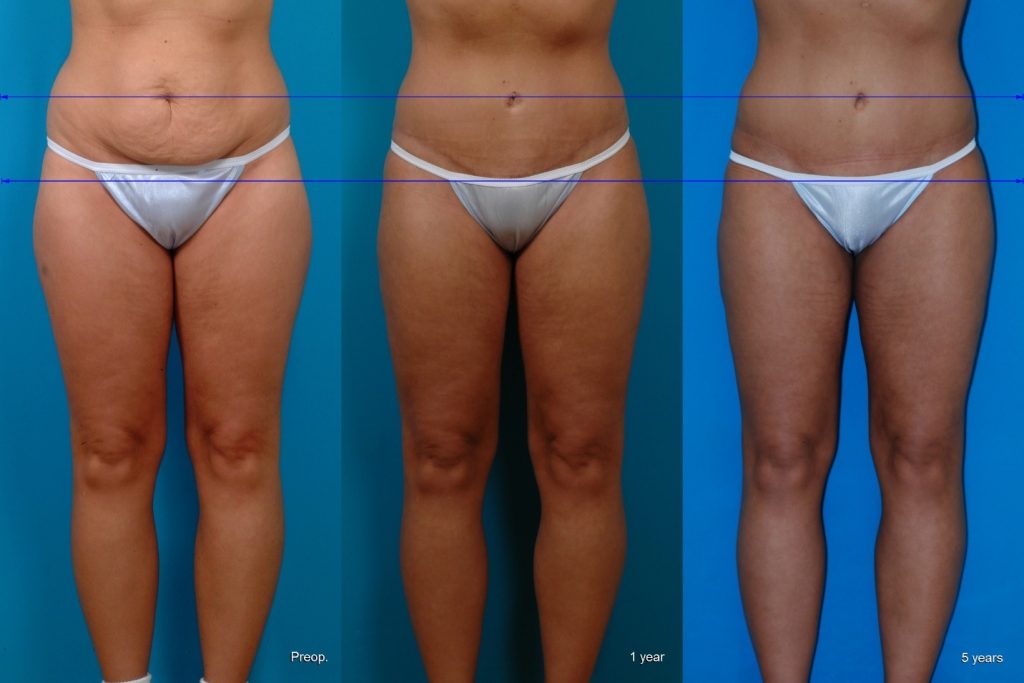
Age 49. Abdominoplasty, liposuction of the abdomen and flanks. 3 months postop.
Schedule a Consultation
The Swanson Center is located in Leawood, Kansas. Call us to schedule a consultation.
Address:
11413 Ash St
Leawood, KS 66211
Tel: +1 913.663.1030
Hours:
Monday – Friday, 9 AM – 5 PM